


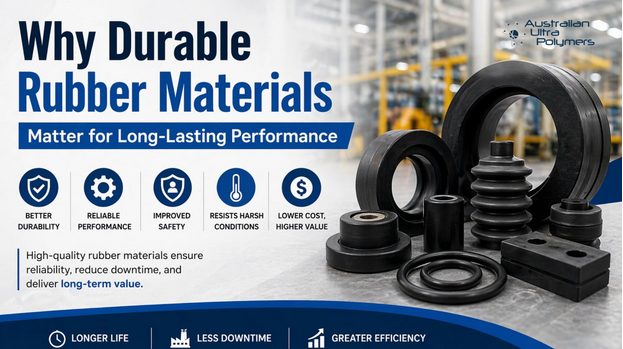

In today’s industrial world, equipment efficiency and reliability depend heavily on the quality of materials used in manufacturing, machinery, and infrastructure. While metals and plastics often receive most of the attention, rubber remains one of the most essential materials across countless industries. It is used in seals, gaskets, hoses, rollers, sheeting, anti-vibration mounts, protective linings, and many other components that support daily operations.
When rubber products are made from low-grade materials, they can wear out quickly, crack under pressure, lose flexibility, or fail in harsh environments. These failures may cause production delays, increased maintenance costs, and safety concerns. That is why choosing durable rubber materials is so important for businesses that want long-lasting performance and lower operating expenses.
High-quality industrial rubber products are engineered to withstand demanding conditions while maintaining strength, flexibility, and reliability over time. Whether used in heavy machinery, transport systems, processing plants, or construction equipment, durable rubber plays a major role in improving productivity and reducing downtime.
Why Durable Rubber Materials Matter
Rubber components are often placed under constant stress. They may be exposed to:
- Heavy mechanical loads
- Repetitive movement and friction
- High or low temperatures
- Water and moisture
- Oils, fuels, and chemicals
- Sunlight, UV rays, and ozone
- Dust, dirt, and abrasive materials
When standard or poor-quality rubber is used, it may harden, split, deform, or wear down faster than expected. This often results in part replacements, machine stoppages, and expensive repairs.
Durable rubber materials are specially developed to resist these challenges. They are manufactured with stronger compounds, better elasticity, and improved resistance to wear and environmental damage.
Key Benefits of Long-Lasting Industrial Rubber
1. Reduced Maintenance Costs
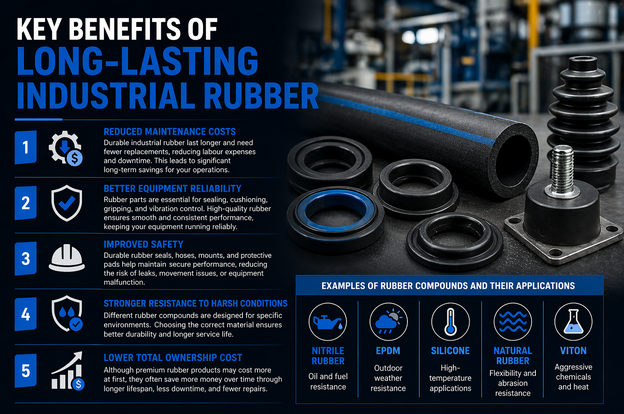
One of the biggest advantages of durable industrial rubber is lower maintenance costs. Components that last longer need fewer replacements, which reduces labour expenses and downtime.
For factories and industrial facilities operating continuously, this can create significant long-term savings.
2. Better Equipment Reliability
Many machines rely on rubber parts for sealing, cushioning, gripping, or controlling vibration. If one rubber component fails, the entire system may stop working properly.
Using high-quality rubber products helps equipment operate smoothly and consistently.
3. Improved Safety
Worn or damaged rubber seals, hoses, mounts, or protective pads can create safety risks. Durable materials help maintain secure performance, reducing the chance of leaks, movement issues, or equipment malfunction.
4. Stronger Resistance to Harsh Conditions
Different rubber compounds are designed for specific environments. Choosing the correct material ensures better durability and longer service life.
Examples include:
- Nitrile rubber for oil and fuel resistance
- EPDM for outdoor weather resistance
- Silicone for high-temperature applications
- Natural rubber for flexibility and abrasion resistance
- Viton for aggressive chemicals and heat
5. Lower Total Ownership Cost
Although premium rubber products may cost more at first, they often save more money over time through longer lifespan, less downtime, and fewer repairs.
The Role of Rubber Moulding in Performance
Precision rubber moulding is one of the most important manufacturing processes for creating dependable rubber parts. Moulding allows components to be shaped accurately according to design specifications while maintaining consistent quality.
Products commonly made through rubber moulding include:
- Seals
- Gaskets
- Bushes
- Mounts
- Custom machine parts
- Protective covers
Benefits of professional rubber moulding include:
- Exact dimensions for proper fit
- Stronger structural integrity
- Uniform density and finish
- Better sealing performance
- Reduced risk of premature failure
Poorly moulded products may contain defects such as weak spots, uneven thickness, trapped air, or inaccurate sizing. These issues can reduce product life and affect machinery performance.
For industries that depend on custom parts, precision rubber moulding is essential for long-term reliability.
Why Rubber Calendering Is Important
Another major process used in rubber manufacturing is rubber calendering. This process involves passing rubber through heavy rollers to create sheets with controlled thickness, smooth surfaces, and consistent quality.
Rubber calendering is widely used for producing:
- Rubber sheeting
- Liners
- Flooring materials
- Conveyor-related products
- Gaskets
- Strips and rolls
Advantages of quality rubber calendering include:
- Uniform thickness across the sheet
- Better surface finish
- Improved strength and consistency
- Easier cutting and fabrication
- Reliable sealing and protective performance
For industries requiring sheet rubber products, calendering quality has a direct impact on final product performance.
Industries That Depend on Durable Rubber
Durable rubber materials are vital across many sectors.
Manufacturing
Factories use rubber in rollers, machine mounts, seals, pads, and conveyor systems.
Mining
Mining operations rely on wear-resistant rubber liners, seals, hoses, and heavy-duty protective parts.
Construction
Rubber is used in expansion joints, weather seals, pads, flooring, and vibration isolation systems.
Automotive and Transport
Vehicles depend on rubber bushes, hoses, mounts, seals, and suspension components.
Agriculture
Farm machinery uses rubber parts exposed to dust, mud, moisture, and outdoor conditions.
Food and Processing
Many processing systems require reliable rubber seals, hoses, and hygienic components.
Choosing the Right Rubber Supplier
The quality of rubber products depends not only on the raw material but also on the experience and capabilities of the manufacturer. Businesses should look for suppliers that provide:
- Custom compound development
- Precision manufacturing processes
- Strong quality control systems
- Technical guidance for material selection
- Fast production turnaround
- Consistent product performance
One trusted Australian manufacturer in this space is Australian Ultra Polymers, known for supplying custom compounds, sheeting, rubber moulding, and rubber calendering solutions for industrial applications.
Sustainability Benefits of Long-Lasting Rubber
Durable rubber materials also support sustainability. Products that last longer reduce waste and lower the need for repeated manufacturing and shipping.
Benefits include:
- Less landfill waste
- Reduced raw material use
- Lower replacement frequency
- Improved resource efficiency
- Reduced maintenance-related energy consumption
For businesses focused on environmental responsibility, choosing long-life rubber products is a practical step.
Final Thoughts
Durable rubber materials matter because they directly affect equipment life, productivity, maintenance costs, and safety. Whether used in seals, sheeting, rollers, custom moulded parts, or vibration systems, high-quality rubber products help businesses operate more efficiently and avoid costly failures.
With reliable industrial rubber, precision rubber moulding, and consistent rubber calendering, companies can achieve better long-term performance across a wide range of applications.
Investing in durable rubber solutions today leads to stronger results, lower costs, and improved reliability in the future.